
TikTok SEO Secrets: 10 Hashtags That Boost Visibility Fast
You posted a video you actually cared about. Clean edit. Strong hook. Real value. It got stuck at 120 views.
That’s not a content problem. It’s a TikTok SEO hashtags problem.
I’ve seen this pattern over and over. Creators assume hashtags are just decoration. They’re not. They’re signals. They tell TikTok who should see your content, and if you send the wrong signals, your video dies before it even gets a fair shot.
In this post, I’ll show you exactly which hashtags move the needle, which ones quietly kill your reach, and how to build a system that gets you consistent discover page exposure.

Here’s What Hashtags Actually Do on TikTok
Most people think hashtags are for “going viral.” That’s not how it works.
TikTok uses hashtags to categorize your content. It decides:
- Who sees your video first
- What audience pool you get tested on
- Whether your content gets pushed further
If your hashtags are too broad, TikTok has no idea who to show your video to.
If they’re too random, it misclassifies your content.
That’s why some videos stall at 200 views while others explode.
Do hashtags increase SEO on TikTok?
Yes, but not in the way people think. Hashtags don’t boost content directly. They improve content classification, which leads to better reach if your video performs well with the right audience.
The 10 Hashtags That Actually Boost Visibility (When Used Right)
1. Niche-Specific Hashtags (Your Growth Anchor)
The Problem:
You’re using broad tags like #viral or #foryou. TikTok throws your content into a massive pool where it gets ignored.
Real Example:
A dental clinic posting oral hygiene tips used #fyp and got 300 views.
Switched to #dentaltips #oralhealthcare #dentistadvice → jumped to 8,200 views.
What to Do Instead:
Use 2–3 hashtags directly tied to your niche.
If your content isn’t clearly categorized, TikTok won’t push it.
2. Mid-Size Hashtags (The Sweet Spot)
The Problem:
Going all-in on massive hashtags means competing with millions of videos.
Real Example:
A fitness creator using #fitness (billions of views) vs #homeworkoutroutine (hundreds of thousands).
The second one consistently performed better.
What to Do Instead:
Pick hashtags in the 100K–1M range. These are easier to rank in.
3. Content-Type Hashtags
The Problem:
TikTok doesn’t just care about your niche. It cares about how your content is structured.
Real Example:
Same creator. Same niche. Different tags:
#storytime vs #tutorial → completely different audience reach.
What to Do Instead:
Use 1 hashtag describing your format:
- #tutorial
- #storytime
- #beforeandafter
4. Search-Based Hashtags
The Problem:
You’re ignoring how people actually search on TikTok.
Real Example:
“how to whiten teeth at home” performed better than generic tags because it matched search intent.
What to Do Instead:
Use hashtags that mirror search queries:
- #howtowhitenyourteeth
- #tiktokseostrategy
How to improve SEO in TikTok?
Think like a search engine. If someone types your topic into TikTok search, your content should match both your caption and your hashtags.
5. Branded Hashtags (Optional but Powerful)
The Problem:
No identity. No recall.
Real Example:
Creators building series content use consistent branded tags and see repeat viewers.
What to Do Instead:
Create 1 unique tag tied to your content or brand.
6. Trending Hashtags (Use Carefully)
The Problem:
Blindly copying trending TikTok hashtags today without relevance.
Real Example:
A business account used trending dance hashtags on educational content. Result: low retention → dead reach.
What to Do Instead:
Only use trending hashtags if they match your content type.
7. Location-Based Hashtags
The Problem:
Ignoring local discovery.
Real Example:
A clinic using #dentalcliniclahore got local clients instead of random viewers.
What to Do Instead:
Add 1 location tag if your audience is geo-specific.
8. Problem-Based Hashtags
The Problem:
You’re describing content, not solving problems.
Real Example:
#toothpainrelief outperformed #dentaltips because it targets intent.
What to Do Instead:
Use hashtags based on what your audience struggles with.
9. Audience Identity Hashtags
The Problem:
Your content isn’t clearly for anyone.
Real Example:
#smallbusinessowner #tiktokcreator helped niche targeting.
What to Do Instead:
Call out your audience directly in one hashtag.
10. Low-Competition Hashtags (Your Entry Point)
The Problem:
New accounts trying to compete with huge creators.
Real Example:
Accounts under 1K followers grew faster targeting smaller hashtags.
What to Do Instead:
Use at least 1 hashtag under 100K posts.
You’re Using #FYP Like It’s a Magic Button (It Isn’t)
Here’s the blunt truth.
#fyp is the most overused hashtag on TikTok and it’s probably hurting you.
It doesn’t boost your reach. It just puts you in the most competitive category possible.
What are the 5 most used hashtags on TikTok?
- #fyp
- #foryou
- #viral
- #trending
- #tiktok
They have billions of uses. That’s exactly why they don’t help smaller creators.

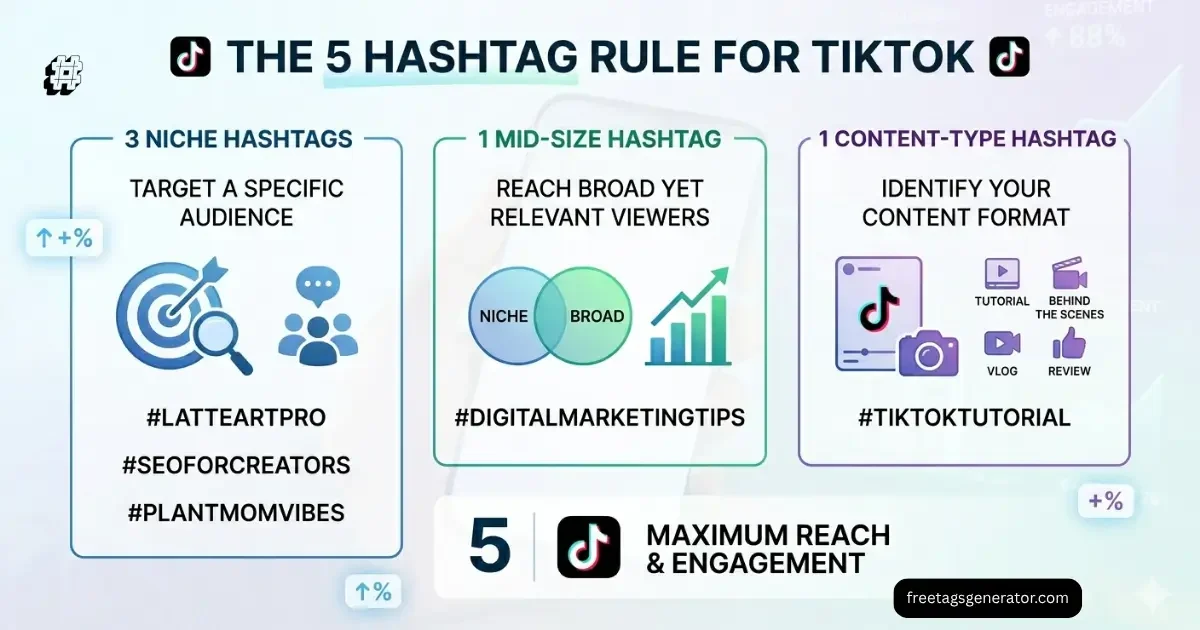
The 5 Hashtag Rule (And Why It Works)
What is the 5 hashtag rule?
Use 3 niche hashtags + 1 mid-size + 1 content-type tag.
That’s it.
More hashtags don’t mean more reach. They dilute your signal.
Is 10 hashtags too many on TikTok?
In most cases, yes. Too many hashtags confuse TikTok’s classification system.
The 3x3 Hashtag Strategy
What is the 3×3 hashtag strategy?
- 3 niche hashtags
- 3 mid-range hashtags
- 3 broader but relevant hashtags
This works well if your content sits between multiple categories.
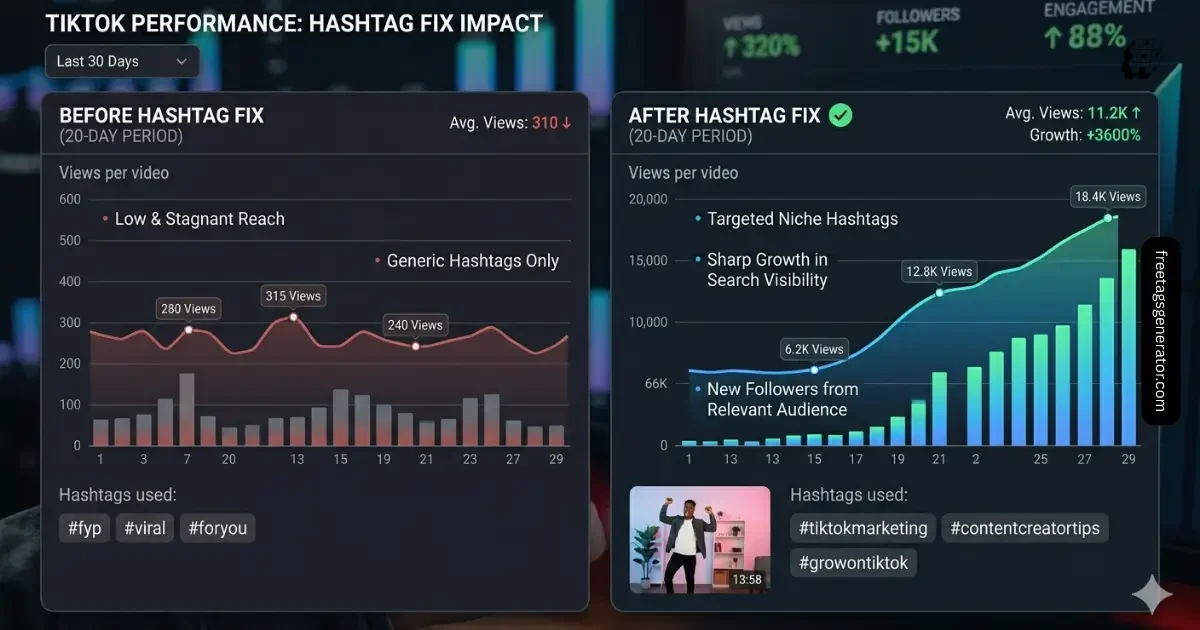
What Actually Changed (A Real Example)
A TikTok automation page I tested:
Before:
- Hashtags: #fyp #viral #tiktokgrowth
- Views: 200–400
- Engagement: almost zero
After:
- Hashtags: #tiktokautomation #contentstrategy #growontiktok #socialmediatips #smallcreators
- Views: 6,000–18,000
- Engagement: real comments, saves, shares
What changed:
The content didn’t improve overnight. The targeting did. TikTok finally understood who to show it to.
Common Hashtag Mistakes That Kill Your Reach
1. Copy-Pasting Trending TikTok Hashtags
You’re following trends instead of building strategy.
2. Using Only Broad Hashtags
You disappear instantly.
3. Ignoring Search Intent
TikTok is becoming a search engine. Act like it.
4. Changing Strategy Every Post
Consistency matters more than randomness.
What are some common hashtag mistakes?
The biggest ones:
- Too many hashtags
- Irrelevant tags
- No niche focus
- Chasing trends blindly
How Many Hashtags Should You Use on TikTok?
Keep it simple.
5 to 7 hashtags is the sweet spot.
Enough to signal clearly. Not enough to confuse the algorithm.
Can Hashtags Help Videos Go Viral?
They don’t make you go viral.
They make sure your video reaches the right people.
If those people watch, engage, and stay — that’s when TikTok pushes it further.
Is 20,000 Views Considered Viral?
Depends on your account size.
For a small account, yes. That’s a strong signal your targeting is working.
What Is the 3 Second Rule on TikTok?
If people don’t watch past the first 3 seconds, your hashtags won’t save you.
Hook first. Hashtags second.
Conclusion
Most creators treat hashtags like decoration. That’s the mistake.
Think of them as instructions to the algorithm. If your instructions are clear, TikTok does the work for you. If they’re messy, your content never gets a real chance.
Here’s what you should do next:
Open your last 3 TikTok posts.
Remove every generic hashtag.
Replace them using the 5 hashtag rule.
Test it for 7 days. Track your views. You’ll see the difference.
If you want to go deeper into content structure and hooks, check this:
FAQs
What hashtags boost TikTok the most?
Hashtags that match your niche and audience intent perform best. Broad tags might look attractive, but they don’t help with visibility for smaller accounts. You’re better off using a mix of niche, mid-range, and search-based hashtags. These give TikTok clearer signals about your content and improve your chances of reaching the right viewers. The goal isn’t popularity. It’s relevance.
What is a banned hashtag?
A banned hashtag is one TikTok has restricted due to misuse or policy violations. Content using these tags may get limited reach or suppressed entirely. These often include spam-related or inappropriate tags. You won’t always get notified when this happens, which makes it tricky. The safest approach is to stick to clean, relevant hashtags tied to your content.
Which TikTok hashtag has the most views?
Tags like #fyp and #viral dominate in total views. But that doesn’t make them effective. High-volume hashtags are extremely competitive, and your content gets buried almost instantly. For growth, smaller and mid-size hashtags consistently outperform these giants. Focus on getting seen, not competing at the top.
What are the top 10 hashtags?
There’s no fixed list that works for everyone. The “top” hashtags change based on trends, niche, and content type. What works for a fitness creator won’t work for a dental clinic or a business page. The better approach is building your own set of high-performing hashtags based on your niche and testing them over time.